

My new favorite pseudonymous writer
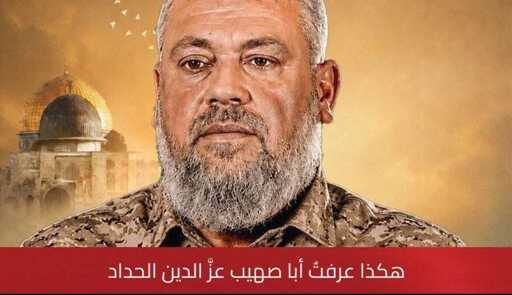
[2026-06-23] @mujammaharaket@twitter.com: I am excited to share this translation of this memoir, “This Is How I Came to Know Abu Suhaib Izz al-Din al-Haddad: And So, I will never forget him.”
Expand post
The original Arabic reflection on Commander Izz al-Din al-Haddad (Abu Suhaib) was originally circulated on private channels. I became aware of it vi Khaled Safi, who kindly gave me permission to translate this into English. This piece of writing was authored by an al-Qassam Brigades fighter writing under the anonymous nom-de-plume, “Abdulaziz.”
The writer not only knew al-Haddad for over twenty years but also worked intimately under him. Based on what this memoir reveals, he also participated in the “Great Crossing” of and the Flood.
This insightful short piece offers some novel historical facts about Qassam’s operational history, including, first and foremost, the specifics of how the Lebanese Hizbu’llah’s closed-wire communication system was imported from South Lebanon to Gaza after a number of Qassam fighters had traveled from Gaza to training sessions with their comrades to the north. Figures like al-Haddad and Fadi al-Batsh helped implement this networked arrangement.
Furthermore, Abdulaziz’s reflections detail how the indigenous weapons manufacturing transpired within Gaza, with al-Haddad playing an important role in this endeavor as well.
Linked in the comments below is the translated memoir, with editorial translator comments. A short excerpt is also appended below: "When the al-Furqan War (2008–2009) broke out, the network quickly proved its worth. Abu Suhaib made extensive use of the network, avoiding wireless communications whenever possible. He also personally oversaw the repair of lines that were repeatedly severed under the relentless bombardment. In the military assessment conducted after the war, Abu Suhaib submitted a strategic report recommending a complete transition to a wired communications network. The group later relied on that report in its efforts to persuade the Qassam Brigades’ Military Council to adopt the concept and institutionalize it as a permanent strategy.
Consequently, what began as a simple idea and a modest switchboard in the al-Tuffah neighborhood gradually evolved into a weapon in its own right. Over time, it burgeoned into a major technical latticework that drew some of the movement’s most skilled engineers and commanded vast resources. Had it not been for God’s grace, and for Abu Suhaib’s willingness to champion the idea and take a chance on it, the communications network would never have seen the light of day in Gaza.
[…]
Abu Suhaib’s maverick leadership did not end there. He became the foremost champion of every unconventional and innovative idea. When […] Haitham Shamali (Abu al-Walid), who was assassinated by occupation agents in July 2025, proposed using GPS technology to guide robotic systems, Abu Suhaib immediately embraced the concept and made a point of attending every field test. He responded in much the same way when another group proposed building a GPS-guided submersible. He worked alongside them to overcome technical obstacles and even personally invited Sheikh Raed Saad to observe the trials and lend his support.
[…]
Our greatest consolation today is that Abu Suhaib did not leave this world before raising a generation of steadfast fighters who will avenge the blood of their leaders and unflaggingly carry on the struggle. Even now, I can see a remarkable generation taking shape, a generation driven by an unyielding love for its land. It is being forged amid the rain of rockets, born from the rubble and the mounting toll of the fallen. It will be galvanized by a generation that has lost faith in the false promises of international justice and the impotence of the aging United Nations international order."