

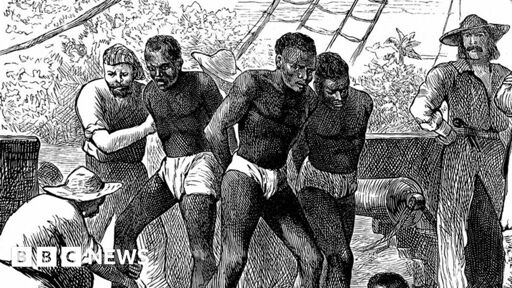
The United Nations General Assembly has voted to recognise the enslavement of Africans during the transatlantic slave trade as “the gravest crime against humanity”, a move advocates hope will pave the way for healing and justice.
The resolution - proposed by Ghana - called for this designation, while also urging UN member states to consider apologising for the slave trade and contributing to a reparations fund. It does not mention a specific amount of money.
The proposal was adopted with 123 votes in favour and three against - the United States, Israel and Argentina.
Countries like the UK have long rejected calls to pay reparations, saying today’s institutions cannot be held responsible for past wrongs.
While I agree in part with the sentiment, I think is totally unfair to consider ancient slavery in Greece or Rome as less cruel. It was not less cruel depending on the slave in question. Slaves in mines and agricultural estates were in worse conditions then anything in American south. But if you were an educated slave then your life was indeed better. That also means that was common for slaves in ancient Rome to be able to buy freedom. Slavery was everywhere in society, so the comparison is really hard to make.
There is indeed a racial component in colonial slavery that was not present in ancient Roman slavery. A slave could be from Germany or from Syria and there was no difference in treatment.
I would say that both late trans-atlantic slavery and nazism share a philosophical root in the eugenetic movement, but both grew in parallel with different motives: in one case a justification for economic exploitation, in the other an ideological tool to enforce unity in nationalism.
The transatlantic slave trade started before the concept of race and the eugenetic movement. During the 15th century the justification was more routed in religion and the idea of having prisoner of war being better then to kill the enemy. Still and excuse for economic exploitation, but maybe more akin to what the greeks and romans were doing.
We can go back and forth about the living and working conditions of various peoples held in bondage through history. I think if we really got down to it we’d find that those subjugated by the transatlantic slave trade had it worse in many ways but I’d like to come back to a few central points.
This was a slave trade on a scale never before seen in human history. 15 to 20% died in transport.
On arrival, people were completely stripped of their identity and personhood. They could not marry, they could not have families. They could not testify in court. They could be killed with a degree of impunity. They were non human property. This is not how slavery was practiced in Greece Rome or in more modern Islamic empires.
The status of being a slave was inherited from one’s parents (also not the norm).
The European colonial powers / slave traders developed a global race based caste system to justify all this. You’re right that it started on a religious basis but that doesn’t justify what it morphed into. We have white supremacists engaging in terrorism today because of this heinous ideology that they chose to normalize.
I think Ghana has a point by bringing this UN resolution to a vote and it’s pretty telling that the US, Israel (and Argentina because of Milei) voted no and every European nation abstained while 123 of 178 countries voted yes. That gives us a good sense of what majority of the world thinks and perhaps where the truth lies, though I understand why the West would want to stay in a bubble / safe space when this discussing this matter.
That resolution is just virtue signaling. It adds non binding untenable principles like an hierarchy of crimes against humanity and reparation across centuries for something that was not an international recognized crime at the time (while we agree it was terrible).
On the countries that voted yes we have:
I do not want to engage in whataboutism, that is not my point. My point is that this vote is full of hypocrisy. We are not voting for change, we are voting for scoring political points on easy propaganda at home (west bad, we good). While I hate the US, I found that the fact they opposed the resolution and the reason why they opposed the resolution was at least honest. None of the countries above that voted yes will do anything in terms of reparation, and they are not required to.
Finally, I have to correct you on something you said: both in the Roman Republic and Greece (Sparta) was legal to kill your slave without justification.
It was legal to kill your slave in America also as long as it was “by accident” and this was justified with biblical passage.
Freeing slaves was much more common in ancient Rome than it was in the transatlantic trade or ancient Greece.
Freed slaves could also qualify for citizenship in ancient Rome while for a century in the US they were either nonpersons or infamously 3/5ths of a “real” person.
As for those that perpetuated slavery in Brazil, it’s well established that Portugese settlers upheld the institution. How did Portugal vote? I wonder why. Now that Brazil is a democracy and those that were subjected to that cruelty have a voice - well that explains why they voted yes, doesn’t it?
I won’t contest any of the dates you’ve brought forward. But I will reiterate that slavery in the Middle East was closer to how slavery was practiced historically. European colonial powers turned slavery into something uniquely and monstrously inhumane so it’s understandable why these nations would prefer to hide from that truth. They created a global race based caste system to justify it, which has been a stain on human morality since then. At least there’s hope in the fact that the majority of the world sees it for what it truly was.
123 nations representative of 75% of the global population agreed with this proposition. It’s convenient to say they all did it to score political points and make a statement. But when representatives of 6.35 billion people say this was uniquely bad (considering all the horrific things that happened in their countries due to colonialism and other tyranical regimes), it may be time to stop and self reflect (for the countries that voted no or abstained).
Sorry, but you totally ignored my points. Did you not understand what I said and why I said it?
Why are you trying to say that the millions of African dead in the Sahara are somewhat to be ignored as slavery in the Arab world was more traditional? You are continuing to dismiss spartan and repubblican Rome slavery as humane when we already established that it was worse in mines and villas (when it was also your right to kill the slave with no need for a workaround?). You are trying to dismiss more than 60 years of free and independent Brazil supporting slavery? Portugal was a kingdom, now is a democracy, why you want to keep today people of Portugal accountable for the actions of kings 20 generation separated by modern Portuguese, but you will not keep accountable descendent from the same people living in Brazil? What is the logic here?
My opinion is that in those 123 nations there are lot of hypocrites that have promoted slavery to the milions of dead in the past but will not pay for the reparation in the preposition nor intend to take responsibility for any wrongdoing of the past. That is my point. Why the double standard? They are just dishonest. If European said “Yes” they would have just lied like all that other nations I cited above lying by saying “Yes”.
The most important point is that slavery practiced by European colonists is specifically designated as chattel slavery because it was uniquely cruel and inhumane compared to slavery practiced in the rest of the world and historically.
Referring to 123 nations representing 6+ billion people as hypocrites is a convenient and dismissive argument. The West can live its bubble / safe space but we know what the rest of the world thinks.
The broader world seems to understand that this cannot be oversimplified into whataboutisms, simple dualisms or be reflected upon without nuance.
The West is welcome to bring its own resolutions but I’d advise against it because if we’re going to keep track of all of the genocides, displacements and chattel slavery commited by one people onto another in the past 500 years it’s going to be a PR nightmare for them.
The colonial forefathers of many Western nation states knew this which is why they sought the destroy evidence of their wrongdoings. A more blatant example of this is Britain’s Operation Legacy. British colonial officials had a tendency to open fire on unarmed civilians (often women and children) and they tried to cover up countless examples of this and other immoral acts. They firmly believed in that race based caste system they helped create, which I mentioned earlier. So even if they were killing innocent non-white people, it didn’t quite matter to them since they weren’t really people from their twisted perspective.
A group of elderly Kenyans who were subjected to rape, torture and castration in British detention camps in the 1950s actually won a case against the British government in 2013 and were paid a $30 million dollar settlement distributed to 5228 people. They even had to fund a memorial to the victims in Nairobi.
Unfortunately most colonial atrocites are past the ‘statute of limitations’ so to speak so I agree that reparations would be complex. I’m just glad that the world sees European transatlantic chattel slavery for what it was and, even if it’s hard for modern Westerners to accept, at least they know how the rest of the world sees it now too. The first step to justice is acknowledgement.
Again, it is like talking to a wall, you are not addressing my points.
I am not referring to 123 nations as hypocrites, I am referring to the dozen of nations that voted “Yes” for slavery reparation but practiced slavery to the millions of dead and do not intend to pay any reparation.
The US already recognized and apologized for chattel slavery with H. Res. 194.
Again, Roman slavery was one of the most massive example of chattel slavery. Brazil was chattel slavery, the Islamic world engaged in chattel slavery (bantu in salts marshes in Iraq, plantation in Zanzibar, Ottomans plantations for sugar and cotton), the Sokoto Caliphate used chattel slavery (modern Nigeria working in plantations)
The vote at the UN was not for recognition, was for reparations, and the diplomats to the countries involved clarified multiple time that was not an internationally recognized crime at the time, so descended can not be held liable for reparations. Anything else is just performative. What exactly do you expect?
I should clarify my prior post in that European colonists were unique in practicing race-based chattel slavery
I am not at all challenging the fact slavery existed in the many societies. Concur with all of your examples but, and this is an important caveat, slavery was not practiced under a further dehumanizing race based caste construct in those societies, it wasn’t industrial on the scale of the transatlantic trade (rather more often based on domestic kinship models), and I would still attribute the perpetuation of slavery in Brazil according to the European colonial model to Portugese settlers. Unfortunately colonialism doesn’t end when colonists leave (as the field of post colonial studies has demonstrated repeatedly).
Even under Shariah (Islamic) law, slaves had the right to be fed and clothed like their masters, the right to marry, and protections against extreme physical abuse. This is not how European colonists practiced slavery via the transatlantic slave trade.
My understanding of your argument is that it boils down to slavery existed elsewhere. I 100% agree that it did. But the way European colonists did it was so much more cruel and inhumane, and I think that’s what the diplomats from 123 of 178 nations are recognizing here, and rightly so.
In short, we need to have some nuance in understanding how slavery is actually practiced. Some forms are more cruel than others. My argument is that the European colonists did it on a scale and with a degree of cruelty (creating a race based caste system on the basis of false science) never before seen in human history.
Their actions created a period where blackness was synonymized with enslavability and the echoes of that vile ideology reverberate into the present day.
That type of global ideological poison, in my view, certainly puts it among the gravest crimes against humanity. Because it’s not just the people they enslaved that were impacted. It changed how people with darker skin were and are perceived even in the present day. It tied a person’s worth to an immutable and plainly visible characteristic, their skin tone. To me, that makes it one of the greatest evils committed upon humanity.
No, they are not. They are asking for reparation, that is the entire point of the resolution. Reparation, it is said so many time in the document it is ridiculous. We want to say that slavery in US plantation was worse because it had a race component? Fine! I agree, but we are playing the game of “which crime against humanity is worse?”. I find it just degrading. Because Ghana does not really care about the life of the US american citizens that descended from the slaves. They want reparation for Ghana. And reparation for losing millions of citizen is the same if you lose them to the Arabs or to the Americans or to your own internal plantations with chattel slavery.
If for you this is not hypocrisy I do not know what to say